Thursday, February 16, 2023

NFTs are not Art?

Last year, Wikipedia editors decided NFTs are not art. And, I have to agree. But, I'm not saying digital art is not art. Digital art can very much be art. The problem is the weird economy of art.

In recent years, the concept of non-fungible tokens (NFTs) has been gaining traction in the art world. NFTs are digital tokens that represent a unique asset or piece of art. They are created by encoding a digital asset onto a blockchain, which makes them publicly verifiable, immutable, and traceable.

However, many people are confused about the purpose of NFTs and view them as art in themselves. This is a misconception. NFTs are tokens that represent proof of ownership of an asset — which includes works of art. 

The value of an NFT lies in the asset it represents, not in the token itself. An NFT does not possess any intrinsic value; instead, the value of an NFT is derived from the asset it represents. It is the artwork that is being bought and sold, not the NFT.

For example, when you purchase an NFT,  you are buying the "rights" to the asset, not the NFT itself. In the case of artwork, you are not actually buying the artwork, as it remains in the possession of the artist or creator. The NFT only provides proof that you own specific "rights" to the artwork. 

For example, when you buy a music CD, you receive the rights to play the music contained on the CD without paying additional fees. But, you cannot copy the CD or give or sell it to someone else. You do not own its contents,

Thus, the real question is whether or not the work of art represented by NFTs is "art. And, since the majority of the work currently represented by NFTs is digital art, the question is aimed specifically at questioning whether digital art is art. But, before I go further, let me say this: there's no reason an NFT can't represent non-digital assets. Someone could create an NFT for Leonardo da Vinci's "Mona Lisa".

So, what is "art"? Art is the expression or application of human creative skill and imagination, typically in a visual form such as painting or sculpture, producing works to be appreciated primarily for their beauty and/or emotional power. An art instructor told me that art begins and ends with emotion; and that everything in between is simply the technology for creating it.

When it comes to art, there is often a distinction between artistic skill and artistic talent. Artistic skill refers to the ability to use a certain artistic medium, like oil and acrylic paint, while artistic talent is the ability to use a skill to create a work of art. Both artistic skill and artistic talent are important to master in order to create a successful work of art. 

Artistic skill is the ability to use a medium to create artwork. This includes learning how to use the tools and materials associated with a particular medium, like oil paints, acrylic paints, or charcoal. It also includes learning how to create different textures and effects. Artists must practice and hone their skills in order to become proficient in using these mediums. 

On the other hand, artistic talent is the ability to use a skill to create artwork. This includes being able to visualize and interpret ideas, as well as having a good understanding of composition, color, and perspective. Talent is the ability to bring together the different elements of an artwork to create a unified piece. It is the ability to transform an idea into a tangible work of art.

While artistic skill and artistic talent are both important, they are not the same. Artistic skill is the ability to use a particular medium to create artwork, while artistic talent is the ability to use a skill to create artwork. Both are necessary in order to create successful art, and artists must practice both in order to become successful.

Digital art is simply another artistic skill. Music and books are forms of art that benefitted from the digital age; whereas, the visual arts lagged behind. So called experts still question whether digital art is art.

The value of art is based on demand. Music and books increase in value as more copies are created and sold. Whereas, visual art loses value when more copies are created. In fact, the death of a visual artist can increase the value of the artist's existing or incomplete works because the artist won't be creating any new works Again, adding more value because of limitations.

In other words, it's basic economics — supply and demand. Demand drives the value in all cases. But, with certain types of art, supply can increase or decrease value. With visual art, the value is set strictly by high demand and limited supply. Whereas, the value for music and books are set by high demand and high supply.

The first person to buy a one-of-a-kind visual art piece — such as a painting or sculpture — is taking the most risk. Over time, the demand will either increase or decrease. And, it becomes more predictable and the value becomes easier to assess.

NFTs provide a way to control the availability of rights and copies that can be bought and sold. Thus, the theory is that even digital art can achieve the same value as the physical versions. And, as I said earlier, there's no reason that NFTs cannot be used as proof of ownership for physical art.

The bottom-line is this: NFTs do not decrease, nor increase, the risk of investing in art. If you are going to invest in visual arts, then you need to understand what makes visual art valuable. NFTs merely provide proof of who owns the rights to the art. And, it gives digital art a chance to be called "real art."

Unfortunately, visual art is stuck in an egotist realm of "I have the only real copy and you don't; nah, nah" syndrome. But, it doesn't mean we can't all enjoy looking at it — and, you can decide, for yourself, if it is art. It is my personal opinion that digital art should be judged by its composition, content, and message, and not by the medium used to create it — nor, by the number of copies in circulation. 

Thursday, February 2, 2023

IRS: Answer a New Question on Tax Forms or Face Consequences

The Internal Revenue Service building in Washington, on Jan. 28, 2019. (Saul Loeb/AFP via Getty Images)

Written by Tom Ozimek, published on January 23rd by the Epoch Times

The Internal Revenue Service (IRS) issued an alert to taxpayers on Tuesday, reminding them that they must report all digital asset-related income and answer a new digital asset question on their 2022 federal income tax return or face consequences such as delayed refunds or even penalties.

The IRS said in a Jan. 24 release that a key change on 1040 forms this year is that the agency has replaced the term “virtual currency” with “digital assets,” in addition to some other modifications to the wording.

The “Yes” or “No” question, which was expanded and revised this year to update terminology, reads as follows:

“At any time during 2022, did you: (a) receive (as a reward, award or payment for property or services); or (b) sell, exchange, gift or otherwise dispose of a digital asset (or a financial interest in a digital asset)?”

The question appears at the top of tax forms 1040, Individual Income Tax Return; 1040-SR, U.S. Tax Return for Seniors; and 1040-NR, U.S. Nonresident Alien Income Tax Return.

“All taxpayers must answer the question regardless of whether they engaged in any transactions involving digital assets,” the agency cautioned.

It is a legal requirement to accurately report all income, including income from digital assets, on federal income tax returns. Failure to do so could result in non-compliance with tax laws and possible penalties.

The IRS has provided a detailed explanation of what constitutes a digital asset, which includes such things as stablecoins, non-fungible tokens (NFTs), and cryptocurrencies.

Taxpayers need to check the “Yes” box if they:

  • Received digital assets as payment for property or services provided;
  • Transferred digital assets for free (without receiving any consideration) as a bona fide gift;
  • Received digital assets resulting from a reward or award;
  • Received new digital assets resulting from mining, staking, and similar activities;
  • Received digital assets resulting from a hard fork (a branching of a cryptocurrency’s blockchain that splits a single cryptocurrency into two);
  • Disposed of digital assets in exchange for property or services;
  • Disposed of a digital asset in exchange or trade for another digital asset;
  • Sold a digital asset; or
  • Otherwise disposed of any other financial interest in a digital asset.

Those who tick the “Yes” box must also report all income related to their digital asset transactions on relevant forms. For instance, an investor who sold cryptocurrency during 2022 would use Form 8949, Sales and other Dispositions of Capital Assets.

Taxpayers should check the “No” box if they merely owned digital assets but didn’t engage in any transactions involving them in 2022.

They should also tick “No” if they merely transferred digital assets from one wallet or account they own or control to another one that they own or control, and if they bought digital assets using real currency like the U.S. dollar.
Many Americans Will See Smaller Tax Refunds

The IRS has warned that many taxpayers should expect a smaller refund this tax season because of tax law changes including the expiration of pandemic-related stimulus payments that would otherwise have boosted refund balances.

“Due to tax law changes such as the elimination of the Advance Child Tax Credit and no Recovery Rebate Credit this year to claim pandemic-related stimulus payments, many taxpayers may find their refunds somewhat lower this year,” the IRS said in a press release on Jan. 23, the day the agency began tax returns for 2022 earnings.

Not all tax filers will see lower refunds as individual circumstances vary; many will see smaller checks.

The Recovery Rebate Credit was a way for millions of Americans to receive pandemic support if they did not receive their full amount via stimulus checks.

This credit was available for missing amounts from the first, second, and third round stimulus checks, and could only be claimed on 2020 and 2021 tax returns.

The stimulus checks were discontinued in December 2021 and the missing third-round amounts could only be claimed on a 2021 tax return filed in 2022.

However, people who may have missed the opportunity to claim missing third-round stimulus payments can review their 2021 tax return and consider filing an amended return.

The Child Tax Credit (CTC) for 2022 tax returns has been reduced to $2,000 per child, down from the expanded amount of $3,600 for children under 6 and $3,000 for children between 6 and 17 in 2021.

Some taxpayers may be eligible for an Additional Child Tax Credit (ACTC), which would allow them to receive up to $1,500 of the CTC as a refund on their tax return.

Also, a tax credit that working parents can use to help cover child care costs or that people with adult dependents can use for the same purpose is lower in 2022.

For tax year 2021, qualifying expenses were raised from $3,000 to $8,000 for one qualifying person and from $6,000 to $16,000 for two or more. The percentage eligible for the credit was increased from 35 percent to 50 percent.

But for 2022, qualifying expenses have been reduced back down to $3,000 for one person and to $6,000 for two or more. The percentage of qualified expenses that can be claimed now range from 20 percent to 35 percent.

The temporary enhancements also made the child and dependent care credit fully refundable. But for 2022, it has become non-refundable, meaning that at best it can only reduce one’s tax bill to zero.


Monday, January 30, 2023

The Digital Dollar is Coming


The world is changing rapidly, and the way we use money is no exception. Fiat currency, or money based on government-issued currency, has been around for centuries and is still the primary form of currency used today. However, with the emergence of cryptocurrency, a new form of digital currency, many people are questioning the viability of fiat currency in the digital age. Now, with the advancement of digital technology, fiat currency is becoming increasingly digitalized. 

But what are the pros and cons of this transition?

Pros

One of the main advantages of digitalizing fiat currency is convenience. Digital currency can be transferred easily, quickly, and securely. It also eliminates the need for physical cash, reducing the risk of theft or fraud. Digital currency can be used for international transactions, eliminating the need to exchange physical currency between different nations. Moreover, digital currency provides users with more control over their funds since it can be tracked and monitored more easily.

Another benefit of digitalizing fiat currency is cost savings. Transactions using digital currency are often cheaper and faster than those involving physical cash or traditional banking methods. This is because digital currency eliminates the need for physical infrastructure or personnel to process payments.

In extreme cases, governments may even freeze the assets of citizens and businesses if they are suspected of engaging in tax-evasion, illegal, and/or anti-government activities. 

The first way that digitizing fiat currency can result in a government freezing or seizing your money is through the implementation of capital controls. Capital controls are regulations imposed by governments on the movement of capital across national borders. Governments may impose capital controls to protect their domestic economies from sudden outflows of capital or to protect their currencies. 

The second way that digitizing fiat currency can result in a government freezing or seizing your money is through the implementation of taxation. Governments can easily track and monitor the transactions of its citizens when its currency is digitized. This makes it easier for governments to track taxable income, and to make sure that citizens are paying their taxes. Governments may also take more aggressive measures to ensure that taxes are paid, such as freezing or seizing the assets of those who are not compliant.

The third way that digitizing fiat currency can result in a government freezing or seizing your money is through the implementation of anti-money laundering laws. Anti-money laundering (AML) laws are regulations that are designed to prevent criminals from using the financial system to launder the proceeds of their illicit activities. If a government digitizes its currency, it can more easily detect suspicious transactions and take appropriate action. This could include freezing or seizing the assets of those suspected of engaging in money laundering activities.

Cons

Despite the many advantages of digitizing fiat currency, there are also some drawbacks. For one thing, the transition to digital currency is still relatively new and has yet to be properly tested or regulated. It is important to remember that digitizing fiat currency is not the same thing as cryptocurrency.

Fiat currency has been around for a long time and has served us well, but it has its shortcomings. Fiat currency is subject to inflation, and its value can be easily manipulated by governments and central banks. Fiat currency is also limited in its use, since it can only be used in the country or region it is issued in.

Digitizing fiat money could be used to thwart democracy by allowing a select few to control the currency and the economy. By digitizing the currency, the government would be able to track and monitor financial transactions, allowing them to gain an immense amount of control over the money supply. A small group of individuals, such as bankers, would be able to influence the value of the currency and manipulate the economy for their own gain, rather than allowing the free market to determine the value of the currency.

This could lead to a situation where the wealthy few have control over the economy, while the majority of citizens are unable to have any influence. This would undermine democracy and the principles of equality and economic justice.

The Better Alternative

Cryptocurrency, on the other hand, is a digital currency that is not controlled by any government or central bank. It is based on a secure blockchain technology that makes it nearly impossible to counterfeit or hack. Transactions are secure, anonymous, and fast, and the value of cryptocurrency is determined by the market, not by governments or central banks.

Thus, cryptocurrency is a form of democracy in that it is a decentralized system that is not controlled by any one entity. Transactions are conducted on a peer-to-peer basis, meaning that no single party is able to control the system. This gives users more autonomy and control over their funds and transactions, allowing them to make financial decisions without relying on a third-party intermediary. 

Cryptocurrency also enables users to store and transfer value without relying on a central bank or government, allowing individuals to transact in a more secure and private way. 

In addition, cryptocurrency is global, meaning it can be used anywhere in the world. This makes it easier and more efficient to send and receive payments, especially to those in other countries. The use of cryptocurrency also eliminates the need for expensive and slow international wire transfers.

Overall, cryptocurrency is a more efficient and secure form of digital currency than fiat currency. It is not subject to inflation or government manipulation, is secure from theft and fraud, and can be used anywhere in the world. It is also decentralized, meaning it is not subject to the same government regulations and taxes as fiat currency. 

Any entity that can control your money inevitably controls you. Thus, freedom requires you to control your own money. And, for all of these reasons, I feel cryptocurrency is a better choice over fiat currency in the digital age.

Wednesday, January 25, 2023

FTX: A Failure of "Centralized Finance"


"FTX Collapse is not a Crypto Failure. It's a failure of centralized finance and a failure of Sam Bankman-Fried." — Rep. Tom Emmer (Minnesota)

"This is really just old fashioned embezzlement. This is just taking money from customers and using it for your own purpose. Not sophisticated at all." — John J. Ray, (curent FTX CEO in a testimony to the House Financial Services Committee)

Summary

FTX is a cryptocurrency derivative exchange that allowed users to trade and invest in derivatives such as tokens, futures, and options. It became very popular as it allowed users to leverage their cryptocurrency holdings and take advantage of opportunities in the market. However, the exchange was not decentralized, and was instead run by a centralized entity that had direct access to the users’ funds.

FTX’s collapse took place over a ten-day period in November 2022. The catalyst was a Nov. 2 scoop by crypto news site CoinDesk that revealed that Alameda Research, the quant trading firm also run by Bankman-Fried, held a position valued at $5 billion in FTT, the native token of FTX.

Following a report suggesting potential leverage and solvency concerns, the exchange faced a liquidity crisis and tried to negotiate a bailout by rival Binance that quickly fell through. Its CEO was later arrested, extradited to the U.S., released on a $250 bond, and he now faces trial in October 2023.

This article explains what happened and provides insight into why it was risky from the start and how to avoid being a victim of these situations.

The Indictment

Prosecutors allege in the indictment that Sam Bankman-Fried was engaging in criminal activity that began as far back as 2019 — in that he deliberately and knowingly “agreed with others to defraud customers of FTX.com by misappropriating those customers’ deposits and using those deposits to pay expenses and debts of Alameda Research,” the indictment alleges.

It also accuses Bankman-Fried of conspiring with others to defraud FTX’s lenders “by providing false and misleading information to those lenders regarding Alameda Research’s financial condition.”

The SEC indictment asserts that Sam Bankman-Fried improperly diverted customer assets to his privately-held crypto hedge fund, Alameda Research LLC, and then used those customer funds to make undisclosed venture investments, lavish real estate purchases, and large political donations.

When prices of crypto assets plummeted in May 2022, Alameda’s lenders demanded repayment on billions of dollars of loans. Despite the fact that Alameda had, by this point, already taken billions of dollars of FTX customer assets, it was unable to satisfy its loan obligations.

In response, Sam Bankman-Fried allegedly instructed FTX to divert billions in investors’ assets to Alameda to sustain its lending relationships and cash flow from lenders and investors. Finally, the SEC claims that, despite becoming clear that the platforms were unable to make customers whole, Sam Bankman-Fried continued to move millions to Alameda, using the misappropriated assets to finance other investments and ‘loans’ to himself and other FTX executives.

The U.S. Attorneys Office for the Southern District of New York charged Sam Bankman-Fried with eight criminal counts: conspiracy to commit wire fraud and securities fraud, individual charges of securities fraud and wire fraud, money laundering and conspiracy to avoid campaign finance regulations. His court date is set for October 2, 2023.

The History

FTX, which was launched inn 2019, was initially well-received by the cryptocurrency community, as it offered a wide range of features and a strong user interface. It quickly gained popularity and had a high daily trading volume. However, the platform was eventually hit with a series of mismanagement issues that led to its decline and eventual collapse.

The first issue was the fact that the platform was not properly regulated. As a result, there was an absence of oversight, which allowed for a number of potential issues to arise. In addition, the platform was not properly secured, which allowed for hackers to access user funds.

Another issue was the fact that the platform had a number of issues with liquidity. This meant that users could not always access the assets they wanted to trade, which caused a lot of frustration. Furthermore, the platform had a number of technical issues that hindered its usability.

In February of 2020, FTX, a rapidly growing cryptocurrency exchange, was accused of using its customer’s cryptocurrency to fund a new venture, Alameda Research, without their customer’s knowledge. This allegation was made public in a blog post from Alameda Research’s CEO, Sam Bankman-Fried, who admitted that FTX had used its customer’s cryptocurrency to fund the venture.

The controversy began when Bankman-Fried revealed that FTX had taken cryptocurrency from its customers and used it to fund Alameda without their consent. According to the blog post, FTX had taken a “small percentage” of customer funds from its exchange to “invest in Alameda”. Bankman-Fried also clarified that the funds were taken from customer accounts that were in “good standing” and that the funds were used to “support Alameda’s research and development”.

The revelation quickly caused backlash from the cryptocurrency community, with many customers feeling betrayed and outraged that their funds had been taken without their permission. Some customers even threatened to take legal action against FTX.

In response to the controversy, FTX issued an apology and clarified that while it had taken customer funds to fund Alameda, it had done so in an effort to “benefit all of its customers”. The exchange explained that the funds taken were a “small percentage” of customer funds that were “not actively being used for trading” and that the funds were used to “help the development of Alameda and its growth”.

Furthermore, FTX also pledged to reimburse any customer whose funds were taken without their knowledge. The exchange also promised to be more transparent in the future and to “actively engage with customers” before taking any action that affects them.

In the end, many customers were still not satisfied with FTX’s response and some even chose to move their funds to other exchanges.

Is Cryptocurrency at Risk?

What happened with FTX did not invalidate cryptocurrency, nor did it make it more or less risky to invest in cryptocurrency. 

The problem is that a lot of investors are just looking for quick returns. They often do not know how to distinguish between decentralized and centralized projects, and they don’t do the due diligence to understand what is behind the coins. They can’t answer what value a specific token holds or whether they believe that it is going to create and sustain some kind of value.

Here are some topics that can help you understand how to avoid an FTX scenario. However, before investing in any cryptocurrency, it’s important to research the technology and its potential applications. Understand the risks associated with the asset before investing. 

Don't trust, validate! You'll need to choose a crypto exchange to buy and sell your coins. And, while there are many exchanges available, you need to research them to determine which one is the best fit for you. Prefer decentralized exchanges over a centralized ones, and avoid exchanges that have direct access to your private keys.

Centralized vs. Decentralized Exchanges

FTX is a centralized exchange that allows users to trade cryptocurrencies with each other. FTX acts as the intermediary between the buyer and seller, taking a fee for each transaction. This is different from decentralized exchanges, which do not have a centralized point of control and instead operate on a peer-to-peer system. 

Centralized and decentralized networks are two types of networks that are used for communication and data transfer. Centralized networks are typically owned and operated by a single entity, while decentralized networks are owned and operated by multiple entities. Each type of network has its own advantages and disadvantages, depending on the application.

Centralized Networks: Centralized networks are typically owned and operated by a single organization. This organization controls the resources and data of the network and is responsible for its security and reliability. In a centralized network, the central authority has full control over the network's resources, data, and communications. This allows the organization to monitor and control the network and its users. One of the main advantages of centralized networks is that they are easier to manage and secure. However, they can also be vulnerable to single points of failure and can be subject to malicious attacks.

Decentralized Networks: Decentralized networks are owned and operated by multiple entities. These entities share the resources, data, and communications of the network. This creates a more secure network as there is no single point of failure. In addition, decentralized networks are usually more resilient to malicious attacks as the data is distributed across multiple entities. Furthermore, decentralized networks are often more efficient as they can better manage resources and data.

Centralized exchanges are the most popular way for people to buy, sell and trade digital assets. Despite the convenience of these exchanges, they come with a number of risks that should be considered before investing.

One of the most significant risks of centralized exchanges is the potential for hacking. As these exchanges have become increasingly popular, they have become a prime target for malicious actors. Hackers can access user data, steal funds, and even manipulate the exchange’s order books. This has led to the loss of millions of dollars worth of cryptocurrency, and has caused many users to lose faith in these exchanges.

Another major risk of centralized exchanges is that they are subject to the regulations of the government or jurisdiction in which they are based. This means that the exchange can be shut down or have trading halted at any time, leaving users unable to access their funds. In addition, governments can impose rules and restrictions on the types of digital assets that can be traded, making it difficult for users to access certain coins or tokens.

Finally, centralized exchanges are subject to the “exit scam”, where the exchange’s operators suddenly disappear with the funds of their users. This can leave customers with no way to recover their money, and can cause them to lose a significant portion of their investments.

Decentralized exchanges, on the other hand, are platforms that allow users to trade digital currencies without relying on a third-party intermediary. These exchanges use a peer-to-peer network to connect buyers and sellers directly, allowing users to trade without having to submit personal information or complete a KYC process. Decentralized exchanges also tend to have lower fees, as users are not required to pay the fees associated with a centralized exchange. Additionally, since the funds are not held by a third-party, users have more control over their funds and are less likely to experience losses due to hacking or other malicious activities.

In conclusion, centralized exchanges are a convenient way to buy, sell, and trade digital assets, but they come with a number of risks that should be considered before investing. Users should be aware of the potential for hacking, government regulations, and exit scams in order to minimize their losses.

The Risks of Custodian Exchanges

When we’re talking about whether an exchange is custodial or non-custodial, what’s actually being taken custody of isn’t the funds in a crypto user’s account, it’s the private key needed to gain access their crypto assets. FTX had control of their customers' private keys; which means the user does not have direct control over the funds and their security. While these exchanges provide investors with an easy way to access the cryptocurrency market, there are some risks associated with entrusting a third-party with your funds.

The most significant risk with these types of exchanges is that your coins are held in the exchange’s wallet, meaning that the exchange has control and custody of your funds. This can create a single point of failure that could lead to your coins being irrevocably lost or stolen if the exchange is hacked or otherwise fails.

In addition to the risk of your coins being lost or stolen, these exchanges also have the potential to become insolvent. This could result in investors not being able to access their funds, as the exchange would have control over them.

Furthermore, cryptocurrency exchanges are not regulated in the same manner as traditional stock exchanges, meaning that there is no guarantee that the exchange will remain solvent or that your coins will remain safe. If the exchange is hacked or otherwise compromised, the user's funds could be lost or stolen. This is why the term "not your wallet, not your coins" is important - it emphasizes the need for users to take responsibility for their own funds and not rely on third parties for security.

Protecting Your Cryptocurrency

The most important way to protect your cryptocurrency is to use a secure wallet. You should also make sure to use a secure connection when sending or receiving cryptocurrency. Additionally, it’s important to keep your passwords and private keys secure, and to never share them with anyone. You should also use two-factor authentication when available and be sure to only transact with trusted parties. Lastly, you should diversify your holdings, spread your coins among different wallets, and keep your coins off of exchanges as much as possible.

What's in your wallet?

A cryptocurrency wallet is a digital wallet used to store, send, and receive cryptocurrencies. It stores public and private keys, which are used to access the cryptocurrency stored in the wallet.

Public keys are like a bank account number, allowing anyone to send cryptocurrency to the wallet. Private keys are like a password, allowing only the owner of the wallet to send cryptocurrency from it. The private key must be kept secure and is used to digitally sign transactions, providing mathematical proof that the transaction has come from the owner of the wallet.

What's the best wallet to use?

When it comes to storing digital currencies, there are two main types of wallets: hot wallets and cold wallets. Hot wallets are those that are connected to the internet, while cold wallets are those that are not connected to the internet. Both types of wallets have their advantages and disadvantages, and it is important to understand the differences between them before choosing which wallet to use.

Hot wallets, also known as online wallets, provide users with the convenience of instantly accessing their digital currency. These wallets are connected to the internet, so users can easily view their balances, send and receive funds, and manage their accounts. These wallets are also easier to use, as they usually have a more user-friendly interface. However, hot wallets have some major security risks. Since they are connected to the internet, they are vulnerable to hackers and other malicious actors.

Cold wallets, on the other hand, are wallets that are kept offline. These wallets are not connected to the internet, which makes them much more secure than hot wallets. Cold wallets provide users with the peace of mind that their digital funds are secure, as they are not vulnerable to hacking or other malicious attacks. However, cold wallets are not as convenient as hot wallets, as users cannot access their funds without first connecting the wallet to the internet.

In conclusion, both hot and cold wallets have their advantages and disadvantages. Thus, the decision of which wallet to use will depend on the user’s needs and preferences. 

  • Hot wallets offer the convenience of instantly accessing funds, but are vulnerable to hacks and other malicious attacks.
  • Hot wallets are great for day-to-day spending. 
  • Cold wallets are much more secure, but they are not as convenient as hot wallets. 
  • Cold wallets are better suited for long-term storage of large amounts of coins and tokens.

Conclusion

The collapse of FTX will have a short-term negative impact on cryptocurrency prices as traders and investors may be concerned about the safety of their funds on the exchange. However, it is important to note that FTX is not the only cryptocurrency exchange, and many other exchanges are still operating normally. In the long-term, the impact of the FTX collapse is likely to be minimal. 

Moreover, the cryptocurrency market is likely to remain resilient and has shown strong growth in the past year despite several negative events.

While the collapse of FTX did not make cryptocurrency more or less risky, it does highlight the need to 

Monday, November 14, 2022

Protect Your Assets

From EXODUS.COM regarding protecting your wallet

Dear Reader,

This week has been ugly (embarrassing) for crypto. Public bickering between crypto exchanges, crashing prices, and perhaps worst of all, lost trust in the crypto industry as a whole.

  • Will prices recover? Yes.
  • Will we learn from our mistakes? We hope so.

Crypto is delivering a transparent and decentralized system that no longer requires us to depend on centralized entities and money custodians like banks and exchanges.

For the first time in history, the blockchain has created a movement to shift power back to the people to manage our assets. So why do we keep relying on outdated institutions that leave leave us high and dry?

Exodus is self-custodial which means the funds you hold in Exodus are yours. Exodus the company does not have access to your crypto like online exchanges or other third parties. We can’t freeze your funds or prevent withdrawls (even if we were to go out of business).  

  • Your keys, your crypto. 
  •  Not your keys, not your crypto.

Learn the difference between your self-custodial wallet, and a custodial service like Coinbase, Binance, and FTX.

Custodial vs.Non-custodial

Ready to get your funds off of exchanges and under your control? We got you covered no matter what device or blockchain network you’re on. And self-custody doesn’t mean you’re all alone. We have 24/7 world-class support to help you navigate crypto and Web3. 

Click Download to take ownership of your crypto right now.

Monday, September 12, 2022

The ETH Big Merge

UPDATE: The Merge was completed on September 15th, without a hitch.

The Big Merge is a planned transition — tentatively scheduled for September 14 — of Ethereum's Consensus Mechanism from "Proof of Work" to "Proof of Stake." In other words, it will replace its current energy-intensive mining protocol with the ETH-staked mechanism to secure the network.

The challenge for developers is the transition must occur while everything is up and running. This is kind of like replacing a jet engine while the aircraft is flying. In order to do this without requiring downtime, a second blockchain — called the Beacon Chain — was created in 2020 and has been running in parallel with the Mainnet.

The Beacon Chain is a blockchain — running in parallel, but fully independent of the Mainnet — that uses the "Proof of Stake" consensus mechanism. By keeping them isolated from each other, a solution can be perfected without risk to the Ethereum network. Since its launch, many have claimed the Beacon Chain to be an absolute success. But, this is software; and, software is the most complex device man has invented. By that, I mean, anything can happen.

Once completed, all future blocks on the Mainnet will be via the "Proof of Stake" consensus mechanism; all (hopefully) without any loss of transactions. However, keep in mind, this is not a new Ethereum version — that is, it's not really changing how the network functions. It is simply bringing the network inline with the original vision by upgrading the consensus mechanism.

The Effect on ETH Price

While Crypto prices have been volatile, the merge is expected to have an effect on the ETH price. There is optimism about the price leading up to the merge; but, then, it is expected to drop after the merge. If the merge goes well, then the price might go up. But, if the merge goes bad, it will definitely cause the price to go down.

This is because investors are trading ETH like corporate stocks; and this is bad. Investing in Crypto is more like investing in a startup. And, traditional startup equity has no liquidity — you don’t invest in a new business with the hope of flipping your shares a month later. However, many traders are doing exactly that, which is why the price is so volatile.

See: Investing in Cryptocurrency

Proof of Work vs. Proof of Stake

Thus, this is a massive undertaking. However, it isn't without criticism.

The "Proof of Work" mechanism has been used to secure the Mainnet since its initial launch in 2015. However, the plan to switch over to the "Proof of Stake" mechanism has been in the plans from the very start.

"Proof of Work" is the most popular consensus mechanism introduced by Bitcoin and used by a few other cryptocurrencies. The theory behind Proof of work is that a certain amount of effort required to post a transaction will reduce the risk of a single person or pool of people to take control of the system.

This mechanism requires miners to excerpt an amount of effort by being the first to find a magic number — referred to as a "nonce" — that is to be attached to a block of data prior to hashing it. Thereby, miners are competing against each other for the right to post a transaction and receive a Bitcoin as a reward. This process requires a lot of computing power and can take up to 10 minutes to complete.

With "Proof of Stake," blocks are verified using the machines of coin owners. The owners offer their coins as collateral for the chance to validate blocks. Coin owners with staked coins become "validators." Validators are randomly selected to validate the blocks.

Thus, in "Proof of Work," miners must buy expensive equipment; whereas, in "Proof of Stake," validators buy tokens. For this reason, Proof of Stake is more energy efficient than Proof of Work. And, therefore, is more eco-friendly.

Mining power in "Proof of Work" is all about the equipment. Lots of computers with fast, powerful CPUs have the biggest advantage.

Mining power in "Proof of Stake" depends on the amount of coins a validator is staking. Participants who stake more coins are more likely to be chosen to add new blocks.

Criticisms

Under "Proof of Stake," Miners will be replaced by Validators (or Stakers). So, what will happen to these miners and their expensive equipment? That's a multi-million dollar question. Thus, miners have a heavy investment (estimated to be around $19 billion) in their craft and many are resisting the merge by threatening to create a hard fork or jump over to ETH Classic.

However, there are critics that say "Proof of Stake" can lead to centralization.Validators have to lock up (or stake) ETH in order to qualify. Currently, this is set at 32 ETH (or, over $55k) — which means, only large investors can afford to be Validators.

But, the counter-argument is that only large investors can afford the equipment necessary to compete as a miner. But, if you decide to not be a validator, you can get your ETH back (albeit, it may be locked up for years without gaining interest). Whereas, a miner's equipment is all he is left — and, the equipment constantly needs to be upgraded.

Both mechanisms require the potential miner to invest a substantial amount of money to participate. "Proof of Stake" offers lower ongoing costs. It is less energy intensive and does not require constant upgrades to the mining setups that "Proof of Work" demands.

However, "Proof of Stake" requires the potential miner to invest in the network; whereas, "Proof of Work" requires the potential miner to invest in equipment, The "Proof of Stake" miner risks losing it all; while the "Proof of Work" miner still has their equipment they can use on other PoW blockchains.

Either way, centralization is a risk. Either too few people are willing to lock up $55k, or too few people can afford to buy and maintain the equipment necessary to compete for transaction validation.

But ultimately, supply and demand determines many of the costs to participate in both consensus mechanisms, and those costs will always fluctuate.


Tuesday, August 16, 2022

The Ethereum Watershed -- by David Hoffman

Reprinted from the Bankless HQ Newletter

By David Hoffman,
Co-Founder of Bankless

In the post-Merge world, Ethereum transactions will flow through a very specific and orderly process. A powerful transaction supply chain is being constructed before our very eyes, and massive power structures are about to emerge.

The current state of the Ethereum transaction supply chain is blunt and naive. We all submit our transactions to the mempool, arbitrage bots descend and fight over the pennies of value, and then miners collate all these transactions to build a block.

In post-Merge Ethereum, this process gets codified and defined into the protocol. This fundamentally allows ETH stakers to harness the value capture at every step, ensuring that the value is passed to them at the end of the supply chain.

I’ve said it many times before, but I still haven’t said it enough: The best lens for a holistic understanding of crypto is through biology.

Crypto is an emergent and organic system, and it mimics the laws of nature. Even though humans are building these structures, the ‘optimal structure’ that has been discovered is one that mimics nature.

After years of R&D, Ethereum devs have built a transaction supply chain that looks a lot like a watershed. A watershed is a land area that channels rainfall or snowmelt to creeks, streams, and rivers, and eventually to outflow points such as reservoirs, lakes, or the ocean.

Transactions (raindrops) rain down on Ethereum all over. Some go to Uniswap, some to Aave, others to OpenSea, NFT mints, DEX aggregators, bridges, token transfers, etc.

But it doesn’t matter where a raindrop (transaction) falls in the Ethereum landscape; it always converges to the same spot and gets there via the same process.

Every raindrop is its own, unique drop that lands in a one-of-a-kind location, but soon the laws of nature take over. Droplets converge into a trickle, trickles become streams, streams into rivers, and rivers eventually pool at the deepest part of the watershed.

ETH Stakers.

I call this… the Ethereum Watershed.


Glossary

For those earlier in their crypto journey, this glossary can help prep you for the rest of the content in this piece.

  • Priority Fee: All transactions on Ethereum come with a priority fee. From the user perspective, this is basically synonymous with a gas fee. The higher you pay, the faster your transaction gets included into the blockchain, because you’re increasing the incentive for your transaction to be selected.
  • Mempool: The mempool (memory pool) is a smaller database of unconfirmed or pending transactions which every node keeps. When a transaction is confirmed by being included in a block, it is removed from the mempool. The mempool is not one canonical thing; each blockchain node has their own version of the mempool. Sometimes, transactions are broadcasted to only specific entities, making mempools incongruent with others.
  • MEV: Maximal extractable value (MEV) refers to the maximum value that can be extracted from block production beyond the standard block reward and gas fees, by including, excluding, and changing the order of transactions in a block. Whoever has the power to order transactions in a block can do so in a way that is favorable to themselves, by ensuring that their transactions capture all available arbitrage opportunities.
  • MEV Searcher: An MEV Searcher is an automated and highly optimized algorithm that scans the blockchain and mempool for potential arbitrage opportunities, and submits transactions that attempt to capture that opportunity when it’s identified. 
  • Transaction Bundle: MEV Searchers produce ‘transaction bundles’, which are a set of complex transactions that all get bundled into one package. It’s a single transaction that has many transactions inside of it. Just like a normal transaction, it also comes with a priority fee, or bribe, for inclusion into a block. 
  • Block Builder: A block builder takes all the transaction bundles that it can, as well as the highest priority fee mempool transactions, and construct a block that is eligible for inclusion. 
  • Block Proposer: You might know a Block Proposer by a different name: ETH Staker. Validating node. Block Proposers propose blocks for inclusion to the blockchain. This is a part of the normal ETH staking process, and is the last step in the transaction supply chain.
  • Forest of Tides: The Sundarbans - AramcoWorld
Forest of Tides: The Sundarbans - AramcoWorld

MEV: How Big?

Every transaction on Ethereum has some sort of value associated with it. If it didn’t, then the sender wouldn’t pay the gas fee. Someone is willing to pay something to change the state of Ethereum. People pay to change prices on Uniswap, they pay to raise or low liquidations levels on Aave, or engage is some sort of financial transaction that changes prices and values on Ethereum.

Every transaction on Ethereum produces a trail of arbitrage in its wake. When someone buys ETH on Uniswap, they dislocate its price versus every other marketplace, and creates a small micro-opportunity for arbitragers to rebalance. All financial transactions leave a wake of tiny little opportunities for arbitrage bots to capitalize on.

When you disturb the balance of a Uniswap pool, arbitrage bots descend, consume the arbitrage, and output a more balanced and healthy ecosystem. The more usage of Ethereum, the more total arbitrage exists. Arbitrage bots are akin to the high-frequency traders in TradFi; there are millions of algorithms looking for the tiniest little discrepancy, and they all race to capture that micro-opportunity.

Let’s talk about $$$.

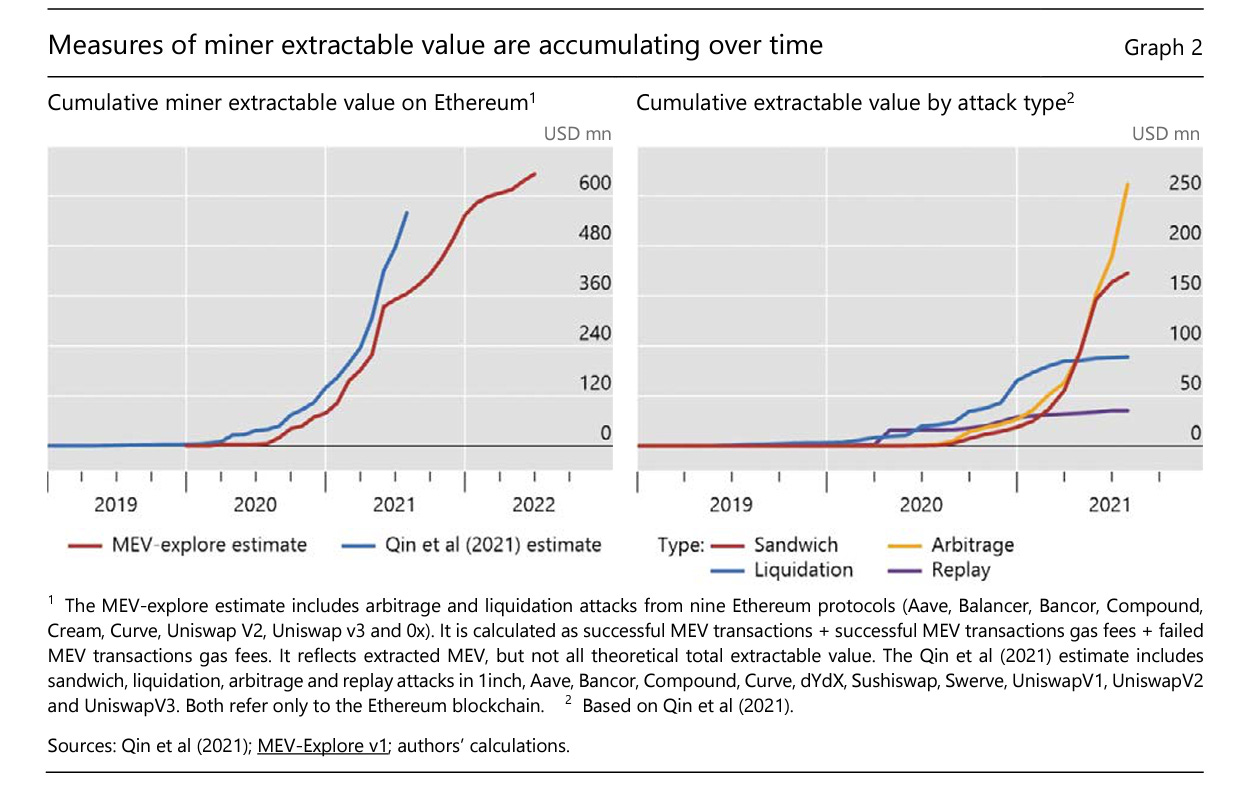
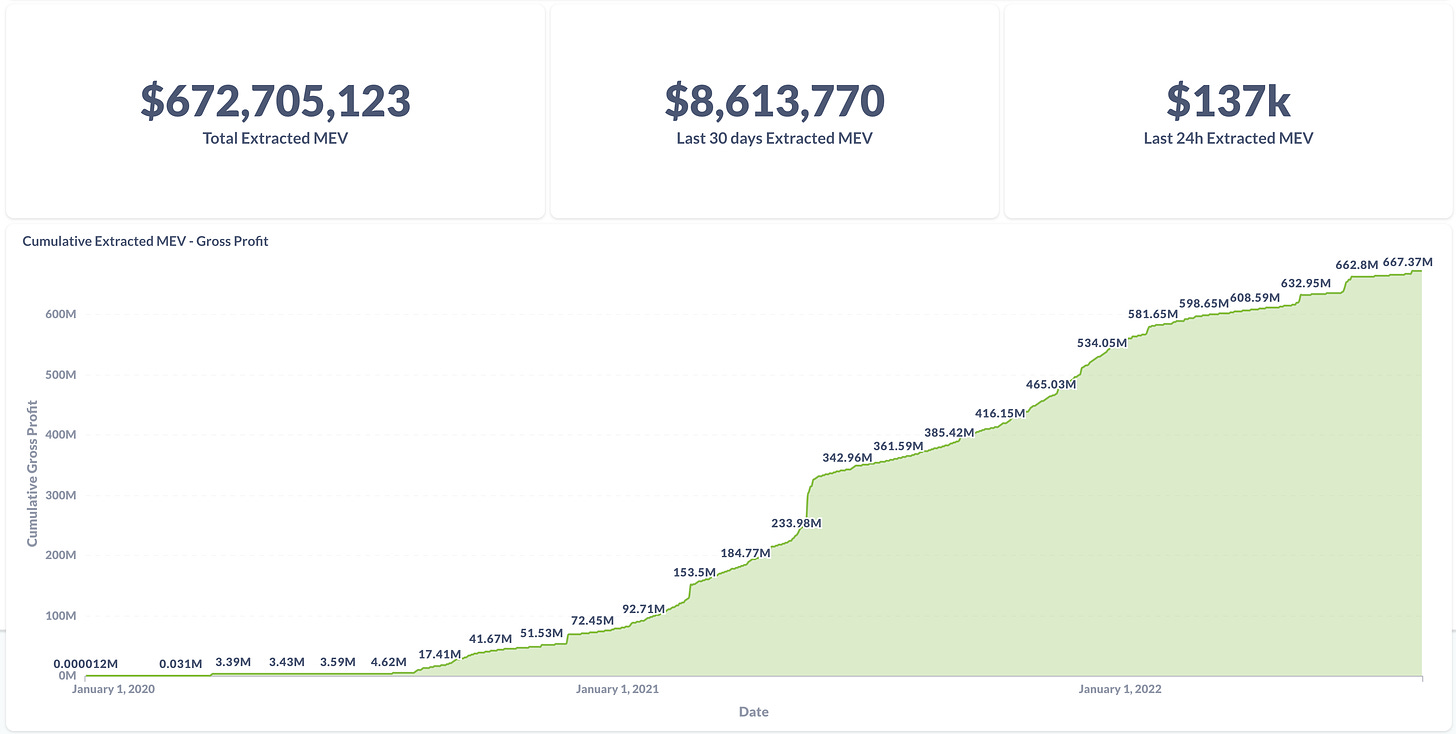
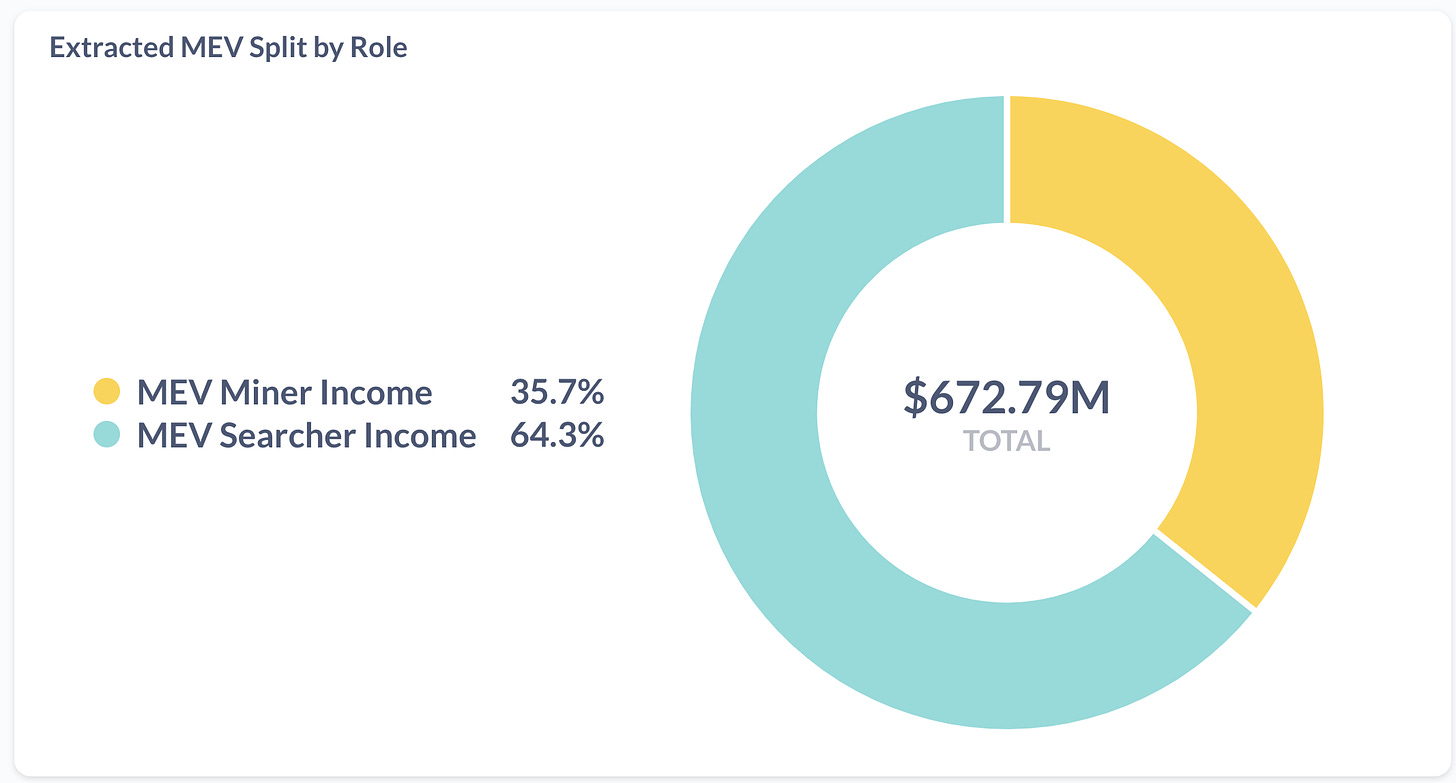
MEV is…uh…really big, amounting to $672M worth of value.

Steady lads… deploying charts:


And this is just the early days of MEV. MEV value capture is such a lucrative industry that it’s bound to increase by orders of magnitude very quickly. No one thinks that it won’t, especially when it’s generally considered that MEV is not a ‘solvable problem’.

At best, it can be harnessed… at worst, it’ll turn your blockchain into an oligarchic hellscape.

    📺 Watch: Crypto’s Existential Crisis

But have no fear! The Ethereum devs are on the case. They’ve produced a system that harnesses MEV and makes it flow downstream to where it can become distributed to the widest number of market participants: ETH Stakers.

The Ethereum Transaction Supply Chain

Step 0️⃣ | Transaction Origination: “The Mempool”

Before transactions become embedded into the Ethereum blockchain, they exist in this ‘unborn’ state called the ‘mempool’. Mempool stands for ‘memory pool’, and it’s basically all of the broadcasted user transactions that have not yet been included in a blockchain.

When you make a transaction on Metamask, you broadcast it out to the Ethereum network of nodes. These nodes download this data, and they hold it in their computer memory.

The transactions that come with the highest Priority Fee get plucked out of the sea of transactions and added to a block for inclusion into the blockchain. I describe in the remaining steps below how transactions are chosen for inclusion, as there are more variables to consider beyond ‘which transaction paid the highest priority fee’.

The important thing to note: The mempool is a massive sea of transactions. Each one has a bid associated with its inclusion, and each one does something on Ethereum.

All transactions have two potential sources of value associated with them:

    Priority Fee: the explicit bribe users can choose to pay for inclusion

    MEV: the second-order effects on the state of Ethereum that produce an arbitrage opportunity

How transactions ultimately become a part of the Ethereum blockchain is a function of both the size of the Priority Fee and all the associated MEV for the transaction.

For example, one could create a transaction that has a $0 fee associated with it, basically asking miners to include the transaction for free. Miners or validators would normally ignore this transaction in lieu of ones that actually pay them money, but if that transaction is something like “Pay 1,000,000 DAI for 1 ETH” or “Sell Cryptopunk #1118 for 1 ETH”, that transaction is going to be immediately scooped up by the first MEV bot to find it.

Simply put, all transactions come with a reward for including it, either explicitly with the priority fee, or implicitly with its implied MEV value. The value of each transaction gets picked up by the next player in the supply chain: MEV Searchers.

Step 1️ | MEV Searchers: “Micro Arbitragers”

MEV Searchers are highly optimized arbitrage bots.

Each MEV searcher bot is optimized for one specific type of MEV, and its creator spends a significant amount of time and labor improving the bot, so that it can produce better arbitrage and earn more profit.

For example, there will be Searchers that are highly optimized to arbitrage imbalances across the various AMMs (Automated Market Makers; aka ‘Decentralized Exchanges’) in DeFi. If ETH is priced at $1998 on Uniswap, and $2002 on Sushiswap, an MEV bot that is optimized for DEX arbitrage will create a transaction that captures this spread and pockets a few gwei.

This same competition occurs internally with borrowing/lending applications like Aave, Maker, or Compound. A significant amount of value is paid to liquidation bots who all race each other to liquidate underwater DeFi loans. Over time, we’ve seen these DeFi liquidation bots compete over smaller spreads, ensuring that the loan is liquidated at the most favorable rate that the market will allow, maximizing how much value is retained by the loan.

There are thousands upon thousands of MEV searcher bots, scouring the mempool, fighting other MEV searcher bots over micro-pennies worth of arbitrage.

As these MEV Searchers get better and more gas-efficient, they will be able to fight over smaller and smaller amounts of arbitrage, organically ensuring that DeFi is a highly efficient marketplace.

Bundling

These MEV Searcher bots create ‘bundles’ of transactions; as it’s often a set of transactions that are required to fully capture the available arbitrage. The Bots need all these transactions to be included in a specific order for their operations to work, so they bundle them up in a neat little package, put a bow on it, and ship it off to the next player in the game: Block Builders.

Just like normal transactors, each MEV searcher bot submits a ‘bid’ with each transaction bundle they create. This is the price that the bots are willing to pay Block Builders to include their bundles. Since this game of MEV arbitrage is highly competitive, the margins become extremely slim.

Since these MEV bots are in a rapid game of bid-escalation, fighting for inclusion, the bids that MEV searchers pay to Block Builders quickly approach the full value of the arbitrage that they extract, meaning that Block Builders capture an amount of value that naturally approaches >99.99% of what the MEV Searchers can extract.

Perfect Competition

Step 2️ | Block Builders: “Macro Arbitragers”

The role of ‘block building’ is simple. Block builders construct the most valuable block possible and then bid to block proposers to accept their block.

This sounds simple, but in order to be as profitable as possible, builders must be highly competitive.

There are two vectors for block builder competition:

  1.     Hardware and networking
  2.     Order Flow

Hardware and Networking

Block builders must undergo a computationally intensive process of transaction simulation.

Builders can’t just blindly include every single transaction bundle without considering its contents. Many bundles submitted by Searchers will be going after the same arbitrage opportunities, and if a lazy builder were to include conflicting bundles, then the 2nd transaction bundle would be rejected, and the builder would forfeit its associated bid.

Bad!

Blockspace is precious, and builders must hyper-optimize the transactions it includes in a block, to make sure they’re not leaving money on the table.

Therefore, block builders go through an intensive transaction simulation process, where it plays out every single transaction, in order to check for conflicts. They will run through all possible permutations of transaction bundles to find the most profitable combinations, then fill the remaining block with basic mempool transactions, put a bow on it, and bid to block proposers for its inclusion.

All within 12 seconds.

    👉Check out Blocknative’s Transaction Simulation Platform

Order Flow

Returning to what I said above about the Ethereum mempool…

The mempool is not a canonical thing. The ‘canonical thing’, the ‘single source of truth’ is the Ethereum blockchain. Until a transaction is ‘in the blockchain’, it’s in a limbo state.

Each and every Ethereum node has its own version of the mempool. When you make a transaction through Metamask (or whatever wallet), you’re broadcasting your transaction to each and every Ethereum node that will listen to you; after all, you just want your transaction included… you don’t really care how.

This is not true for every actor. Broadcasting a transaction is ‘showing your cards’. You are telling the world what you want to do. If ‘what you are doing’ is synonymous with ‘I have a bunch of alpha the market doesn’t know about’, broadcasting that transaction to everyone willing to listen is a sure way to lose every penny of that alpha that you’re trying to receive.

    📺Watch a very old episode of Bankless: “Ethereum is a Dark Forest”

Okay, so you see a bunch of alpha on Ethereum… but if you broadcast your transaction, you’re going to reveal that alpha to some MEV bot, who is sure to beat you to the punch… because that’s what they do.

What do?

Private Order Flow.

Instead of broadcasting this transaction to everyone, you make an off-chain agreement with a mining pool that agrees to process your transaction without broadcasting it to everyone else.

Flashbots, god bless them, has produced ‘Flashbots Protect’ to democratize access to this power. You can check it out here.

The lesson to be learned here: not all mempools are created equal. Entities with better mempool vision and access to private transaction order flow will be able to capitalize on arbitrage opportunities that the rest of the market.

These are the vectors that Block Builders compete on: who can see the mempool the best, either with improved hardware and networking, or private off-chain agreements for order-flow.

Bidding for Blocks

Block builders make money by collecting all the bids from all the transaction bundles from MEV searchers, and all Priority Fees from individual transactions. This will turn into a block that will net them 2.2 ETH, for example. They will then make a 1.9 ETH bid for this block to be proposed by a Block Proposer, in an attempt to pocket the 0.3 ETH spread.

Just like MEV Searchers, block builders will be highly competitive. A really good block builder could produce a block that has 3 ETH of value associated with it, and bid 2.2 ETH for its inclusion… but another block builder could build a block with only 2.4 ETH of value in it, and bid 2.3 ETH for its inclusion.

Naturally, the rational block proposer will accept the 2.3 ETH bidding block, and the builder who took the smaller spread will pocket the cash.

The margins collapse extremely quickly.

Step 3️ | Block Proposers: “ETH Stakers”

The last step is where the block actually gets added to the blockchain!

ETH Stakers, those who are running a validating node, simply select the block that has the highest bid associated with it.

They don’t even need to do any work. They simply select the most profitable block header and sign a message saying that they approve of this block with the full faith and credit of their 32 ETH bond.

And FINALLY, we get to the part of this piece that was the entire point all along.

💡 The Takeaway: Equality via Mechanism Design

Ethereum developers have spent an insane amount of time and R&D into making ETH staking as accessible and democratic as possible. There has been a massive effort that has gone into making ETH staking possible on basic consumer hardware, using the minimum amount of ETH possible (32 ETH, read this thread for why it’s the current theoretical lowest number).

These are Ethereum’s values: make home validation and participation in consensus as democratic and accessible as possible. It shouldn’t matter what your background is, all you need is basic consumer hardware and some ETH, and you can participate in Ethereum staking. App layer innovations like Rocket Pool and Lido help lower the 32 ETH threshold and in the future, it’s possible for 32 ETH to be lowered to 16 or even 8 for solo stakers.

We’ve discovered that MEV is a huge problem in Ethereum, that threatens to centralize the supply of ETH to a few privileged parties that can extract MEV better than anyone else. This reality threatens the entire effort of keeping Ethereum decentralized and democratic.

So what did the developers do? They used mechanism design to harness MEV and place it into the hands of the ETH holders.

As an ETH Staking individual, ask yourself… do you know how to run an MEV searcher bot? Do you know how to build the most optimal block? With the above process, you don’t have to. The entire supply chain is beholden to the most decentralized and accessible part of the stack: ETH holders.

The margins of MEV Searcher bots get maximally compressed by the fight for inclusion by block builders. The margins of block builders get maximally compressed by the fight for inclusion by block proposers.

And block proposers are the ETH Stakers.

All of the potential centralization threats of the best MEV searchers bots get passed downstream to the block builders, which get passed downstream to ETH stakers.

And this is really, really, really bullish for ETH.

Does it really end at the ETH Stakers?

Not necessarily.

Matt Cutler from Blocknative thinks that this competition will actually return back to the point of Transaction Origination: the wallet.

Since every transaction has an associated value with it, the wallet becomes a very powerful place of consumer interaction. Wallets become the source of proprietary deal flow; deal flow that block builders can capitalize on.

So block builders are likely to pay wallets for their transaction flow. For example, a specialized block builder could pay Metamask a lot of money to only route transactions to them, and not broadcast them to the world.

This sounds bad! Metamask users are going to have their transactions fleeced just like Citadel and Robinhood!

I don’t think it will be like this. Instead, I think it will result in something like credit card points or airline miles… but instead with actual monetary rewards like ETH or DAI.

Wallets will pay you to use them. All the margins that are extracted by this process might logically conclude with the transaction originator (that’s you!) with a rebate or kickback by your wallet service provider.

And naturally, this concludes the Ethereum Transaction Watershed cycle.

After the value of transactions has converged on a central pool: ETH stakers, it evaporates into the air, condenses into clouds, and rains down upon the mountains once again, returning to the top of the funnel, and feeding the Ethereum ecosystem with a constant flow of nutrients to feed off of.
The Water Cycle | Precipitation Education


The Water Cycle | Precipitation Education


Congrats fam, we built a self-perpetuating ecosystem 💪

Let a thousand dapps bloom.


Thanks for reading!

- David

Tuesday, August 9, 2022

The Cryptocurrency Landscape

Bitcoin has not only been a trendsetter, ushering in a wave of cryptocurrencies built on a decentralized, peer-to-peer network but has also become the de facto standard for cryptocurrencies, inspiring an ever-growing legion of followers and spinoffs. In fact, there are thousands of digital tokens available.

Some are intended to be currency. Others are intended to be tokens representing currency. For example, casinos and arcades use tokens. In the case of casinos, you trade fiat money for the tokens to use for placing bets. Then, you trade your tokens for fiat money when you leave.

When you trade fiat money for cryptocurrency, the fiat money is being used to build the infrastructure. For example, when you buy Ether, the fiat money you use to buy the digital coins are used to build the Ethereum infrastructure.

What is Bitcoin (BTC)?

Bitcoin is the world’s first successful decentralized cryptocurrency and payment system, launched in 2009 by a mysterious creator known only as Satoshi Nakamoto. 

Bitcoin is built on a distributed digital record called a blockchain. As the name implies, blockchain is a linked body of data, made up of units called blocks containing information about each transaction, including date and time, total value, buyer and seller, and a unique identifying code for each exchange. Entries are strung together in chronological order, creating a digital chain of blocks.

While the idea that anyone can edit the blockchain might sound risky, it’s actually what makes Bitcoin trustworthy and secure. For a transaction block to be added to the Bitcoin blockchain, it must be verified by the majority of all Bitcoin holders, and the unique codes used to recognize users’ wallets and transactions must conform to the right encryption pattern.

What is Ether (ETH)?

Ether is the transactional token that facilitates operations on the Ethereum network. All of the programs and services linked with the Ethereum network require computing power (and that computing power is not free). Ether is a form of payment for network participants to execute their requested operations on the network.

Ether is the world’s second-largest virtual currency by market capitalization as of 2021. It is second only to Bitcoin (BTC), according to market value. Ethereum’s live blockchain was launched on July 30, 2015. Unlike bitcoin, the total number of ether tokens does not have an absolute cap—it changes and grows constantly according to demand. As a result, the Ethereum blockchain is significantly larger than the bitcoin blockchain, and it is expected to continue to outpace bitcoin in the future.

Another key difference between the two is that, while the bitcoin blockchain is simply a ledger of accounts, contributors to the Ethereum blockchain can build more code into the transactions, creating what are called “smart contracts.” So transactions on the Ethereum network may contain executable code, while the data that is connected to bitcoin network transactions are generally only used for record-keeping.

Ethereum developers started working on shifting the network from a proof-of-work (PoW) system to a proof-of-stake (PoS) system in 2017. The new underlying network is known as Ethereum 2.0. The purpose of upgrading to Ethereum 2.0 is to make the underlying network faster and more secure.

What is Tether (USDT)?

Tether (USDT) is a cryptocurrency stablecoin pegged to the U.S. dollar and backed "100% by Tether's reserves," according its website. Tether is owned by iFinex, the Hong Kong-registered company that also owns the crypto exchange BitFinex.

Tether was launched as RealCoin in July 2014 and was rebranded as Tether in November 2014. It started trading in February 2015.  Originally based on the Bitcoin blockchain, Tether now supports Bitcoin's Omni and Liquid protocols as well as the Ethereum, TRON, EOS, Algorand, Solana, OMG Network, and Bitcoin Cash (SLP) blockchains.

As of May 2022, Tether was the third-largest cryptocurrency after Bitcoin (BTC) and Ethereum (ETH), and the largest stablecoin with a market capitalization of nearly $83 billion. In April 2022, Tether's USDT accounted for two-thirds of exchanges out of Bitcoin by value.

What is Dogecoin (DOGE)?

Dogecoin started out as a joke. But, still managed to gain a following. It was participating in the cryptocurrency bubble that show up the values of many coins. However, like many coins, Dogecoin lost much of its value in 2018. However, it still has a core of supporters using it for content on Twitter and Reddit.

What is Solana (SOL)?

Solana is a blockchain platform designed to host decentralized, scalable applications. Solana uses a "proof of history" consensus algorithm, and claims to be much faster in terms of the number of transactions it can process, with significantly lower transaction fees than Ethereum.

What is HBar (HBAR)?

HBAR is the native cryptocurrency of the Hedera network and has a fixed supply of 50 billion HBARs. It’s used as network fuel to pay for transaction fees and for in-app payment and micropayments.

What is Ripple (XRP)?

Ripple is a money transfer network designed to serve the needs of the financial services industry. XRP is the native cryptocurrency on the Ripple network, and it consistently lists among the top 10 cryptocurrencies by market capitalization.

What is Litecoin (LTC)?

Litecoin (LTC) is an alternative cryptocurrency created in October 2011 by Charles "Charlie" Lee, a former Google engineer. Litecoin was adapted from Bitcoin's open-source code but with several modifications. Like Bitcoin, Litecoin is based on an open-source global payment network that is not controlled by any central authority. Litecoin differs from Bitcoin in aspects like faster block generation rate and use of Scrypt as a proof of work scheme.


Thursday, July 28, 2022

Investing in Cryptocurrency


Investing in cryptocurrency is not like investing in stocks and bonds. It's kind of like investing in startups — but, different. In truth, there's nothing really like it.

With stocks, investors are buying a fraction of the ownership of a company. They buy shares of stock if they believe the company's value will — within a reasonable period — be worth more than they paid for it. And, they can rely on established metrics like a stock’s price-to-earnings (PE) ratio for a sanity check. Thereby, the value of the stock is the same thing as the value of the company it represents.

Cryptocurrency doesn't work the same way. First, there are no sanity check tools. Second, the investors are buying digital currency with fiat money. Think about that, for a second. The unit of measure for expressing the value of a digital coin is, currently, the fiat money used to purchase it. 

Isn't the plan for cryptocurrency to replace fiat money?  After all, I can buy a Tesla with cryptocurrency. But, I can't pay my phone bill with IBM stock. 

Long-term vs. Short-term Investments

On one hand, long-term crypto investors are betting we will, very soon, be able to pay all of our bills with cryptocurrency. On the other hand, the short-term investors are betting the cryptocurrency will be worth more than the fiat currency used to purchase the digital coins. But, where is the value in cryptocurrency coming from? The answer is simple: Supply and demand.

However, unlike the U.S. Dollar, the supply for Bitcoin and Ether — and most digital coins — is locked. Which means, their value can only be affected by demand. Whereas, the value of the U.S. Dollar is affected by both, and usually drops every time more money is printed. 

Case in point: there was a time when you could buy a bottle of CocaCola for five cents. Why does it cost over a dollar, now? Did the supply go down or the demand go up? No. The value of money went down because more was printed.

So, where is the demand for cryptocurrency coming from?

Long-term crypto investors are holding onto their cryptocurrency because they believe it will go mainstream. In which case, they see demand for the digital currency being driven by trust in it over fiat money because of its technology. But, this goes against traditional advice regarding holding onto cash.

Short-term investors are speculating there will be more people who believe it will go mainstream than those who don't. In which case, they are betting the demand will increase as more long-term investors buy into the cryptocurrency craze. The short-term investors are not necessarily betting it will go mainstream; they are simply betting the number of people who believe it will go mainstream will increase.

It is these short-term strategies that feed the skeptics with arguments focused on speculative excess and Ponzi schemes. After all, how can crypto live up to the hype if it feels like a roller-coaster ride without safety constraints? 

What the skeptics are not seeing, however, is that this is a young industry, where most of the projects are barely five years old. If the long-term investors are right, the digital coins will be treated as currency and will serve other specialized functions. But, for now, they are actually start-up equity for this emerging technology. 

So, how does this change anything? It changes how we see crypto investing.

Traditional startups have no liquidity at the start. If crypto were a traditional start-up business, smart investors would invest for the long-term. They would not want to flip their shares a month after they invested in it because it wouldn't have time to create value. But, crypto isn't a traditional startup. It has liquidity and the short-term investors are taking advantage of this by buying digital coins on the speculation that it will go up in value. In other words: someone will want it more than they do.

Short-term investors are focused on demand. It is demand that is causing the price to go up and down. And, it is the short-term investors who are creating this artificial demand. However, when the real demand hits a certain point, cryptocurrency will become the baseline that everything else is measured against. In other words, it won't be the value of cryptocurrency going up that makes it appear expensive; it will be the value of the fiat money going down. This is the point in which it goes mainstream. Long-term investors are focused on the technology as being the driver to crypto becoming mainstream.

Long-term vs. Short-term Risks

The short-term risks are highly volatile and tend to follow the stock market trend — except, more exaggerated. If you are a short-term investor buying while the stock market is falling, you risk losing it all. On the other hand, you might see hefty profits if the market is on an upward trend.

But, what makes short-term investing in cryptocurrency very risky is that you have no tools to help you decide when to hold them and when to fold them. You might have better odds playing craps in the casino.

The long-term risks tend to lessen as more people accept it as currency. For this reason, skeptics call it a Ponzi scheme. From the perspective of the short-term investor -- buying and selling on the winds of the stock market -- then, it would appear to be something like a Ponzi scheme. Each trade is simply trading money with the hopes that someone will want my currency more than their currency.

However, for the long term investor who believes cryptocurrency going mainstream is inevitable, the risk is reversed. Those who invest later have less risk than those who invested earlier — but, the potential of making big profits favors those who invested earlier. Thus, bigger risk, bigger return. The risk, however, is that their investment is tied up until crypto goes mainstream. On the other hand, crypto might be inevitable, but it doesn't mean their currency will be the chosen one.

But, first, why would anyone prefer virtual money over physical money? 

Digital Currency is Inevitable

Interestingly, China is currently experimenting with replacing their fiat money with digital currency — called e-CNY. The U.S. has also been researching how to go to the digital dollar for several years (CDBC). Thus, governments see value in digitizing fiat currency. But, these are not the same thing as cryptocurrencies. 

So, why buy cryptocurrency if fiat money will be going digital, anyways?

It's all about trust. How do you feel about the government having direct access to all of your transactions? How would you feel about the government knowing everything you've earned, bought and sold? What kind of control can governments have if they have direct access to our digital wallets?

The fact is, they already know about our debit and credit card transactions. Banks and credit card companies are required to provide this data to the government. Also, the government can freeze our bank accounts at any time via a court order. But, with the currency being digital, there's no place you can hide your money.

Unlike digital fiat money, cryptocurrency is transparent, trustless, and, most importantly, private. It is not run by any one entity, government, agency, company, or person. Crypto is a problem for governments who want to go digital in order to gain more control.

According to a survey from a cryptocurrency exchange service, cryptocurrencies could see mainstream adoption within ten years. The only way this will happen is for consumers to trust crypto over fiat money -- even if that fiat money is digital. Even more complex, consumers need to trust a whole new financial system over the current one.

But, which cryptocurrency will be the one to replace fiat money? Currently, there are thousands of flavors of digital coins using different implementations of the distributed ledger technology.

Mainstream Adoption

Mainstream adoption will be based on three key indicators:

  1. Trust
  2. Ease of use
  3. Business adoption

Trust

Although, security is a number one concern, trust is more than just about keeping your hard-earned cash safe. It is also about keeping your privacy safe. Crypto is designed around trustless protocols; meaning, we trust the system more than we trust the people using the system. Thus, it offers trust without the need to use third-party entities to provide trust.

Ease of Use

In order for it to reach mainstream adoption, it has to be easy to use. Credit and debit cards have already made it easy for us to spend money without have to carry cash on us. In other words, we've already been groomed for digital money. What's in your pocket? Are you carrying cash or plastic?

Business Adoption

Blockchain technology is projected by many analysts to one day have a significant impact on business — if it isn't already happening. It has the potential to improve efficiency and effectiveness, cut costs, and increase revenue. This promise has led many companies to invest time and resources in blockchain pilot projects.

Most likely, the flavor of cryptocurrency to see mainstream adoption will be the one accepted by businesses — more specifically, the retailers. Smart contracts and NFTs can save businesses substantial profits by eliminating services that are inserted in the middle of the sale transactions.

Many of these services are there to protect businesses and consumers from untrustworthy entities. Some are there to make it more convenient for the business or consumer. After all, businesses want to make the sale process as painless as possible for their consumers. But, these services come with a price. And the cryptocurrency technology can help retailers circumvent the need to for many of these services.

However, retail is not the only sector that can benefit from the crypto technology. Businesses are researching the use of blockchain technologies in their supply-chain. Inventory management, tracking, obsolescence, regulatory compliance, and so on. There are too many possibilities to talk about in this article. The point to take from this is that businesses are seriously looking into cryptocurrency to help tap into lost profits or increased savings.

Bottomline: businesses are poised to adopt cryptocurrency.

Challenges for Businesses

Although blockchain technology is expected to have a positive impact on businesses, there are challenges. And, many of these challenges are stopping businesses from fully adopting this technology, today.

As a means of processing transactions, blockchain-based systems are comparatively slow. Its sluggish transaction speed is a concern for businesses that depend on high-performance. Also, a lack of standards and interoperability between various blockchain platforms and legacy solutions is another challenge. 

But, there is good news for the long-term investors: progress is being made in addressing these obstacles. Developers are working on increasing transaction speeds, providing interoperability and standards, and making it easier to implement solutions on the blockchain.

Summary

Investing in cryptocurrency requires understanding what it is about and how it will become mainstream. You can take the riskiest route by being a short-term investor, or take the less risky route by being a long-term investor. However, the less-risky route is still very, very risky.

There are many flavors of crypto in the market. So, deciding which one to bet on is tricky. 

When there was only one player -- Bitcoin -- then, the decision was easy. What about Ether? It is a powerful contender with a strong technology. And, then, there are crypto implementations, like HBAR, which runs on a DAG-type of ledger and promises higher speeds with a better consensus mechanism.

Fiat money will eventually go digital -- whether it be replaced with crypto or is simply digitizing the existing fiat currency. The financial district is bound to go through some massive changes in the next few years.

So, how do you invest in crypto? That's the million dollar question. In the next few articles, we'll investigate the more popular flavors of crypto -- their advantages and disadvantages -- in search of information that can help us answer that question.

Also, we'll look at NFTs. Investing in NFTs is much more straightforward -- if, again, you understand what you're really investing in.